Ice Cream
My parents have a lot of memorable furniture. Their home feels curated in the best way. Each piece was chosen at a specific point across a lifetime of international living. Even amidst all this quality, I have a favorite: my great grandmother’s oak ice box.
Box as a descriptor is an undersell. It looks more like an armoire, a fortified chest fitted with brass latches, a cabinet befitting a gateway to a mysterious kingdom. What’s even more mind-blowing for a Millennial than a piece of furniture constructed of solid wood is its original function: holding a fifty pound block of ice to keep food cool for a week.
Before refrigeration, this was an entire industry. You saw it in the movie Frozen. Men cutting giant blocks of ice from frozen lakes, transporting them by mule team to vast ice houses insulated with sawdust, and then delivering them to local shops and people’s homes. I wonder if I would have had what it takes to serve frozen desserts in the late nineteenth century.
This is important because I love ice cream. We love ice cream. It’s everywhere on my list of top three desserts (I say everywhere because the other two are pie and cookies, both of which are improved by the presence of ice cream, so the ranking order gets a little confused).
We made a lot of ice cream at the restaurant. It’s a perfect dessert because it’s both delicious and fully prepared (almost indefinitely) in advance. Good ice cream is all about texture, and no low-fat or eggless approximation can compete with the creaminess of a custard base (though Frankie & Jo’s plant-based ice cream here in Seattle is pretty darn close).
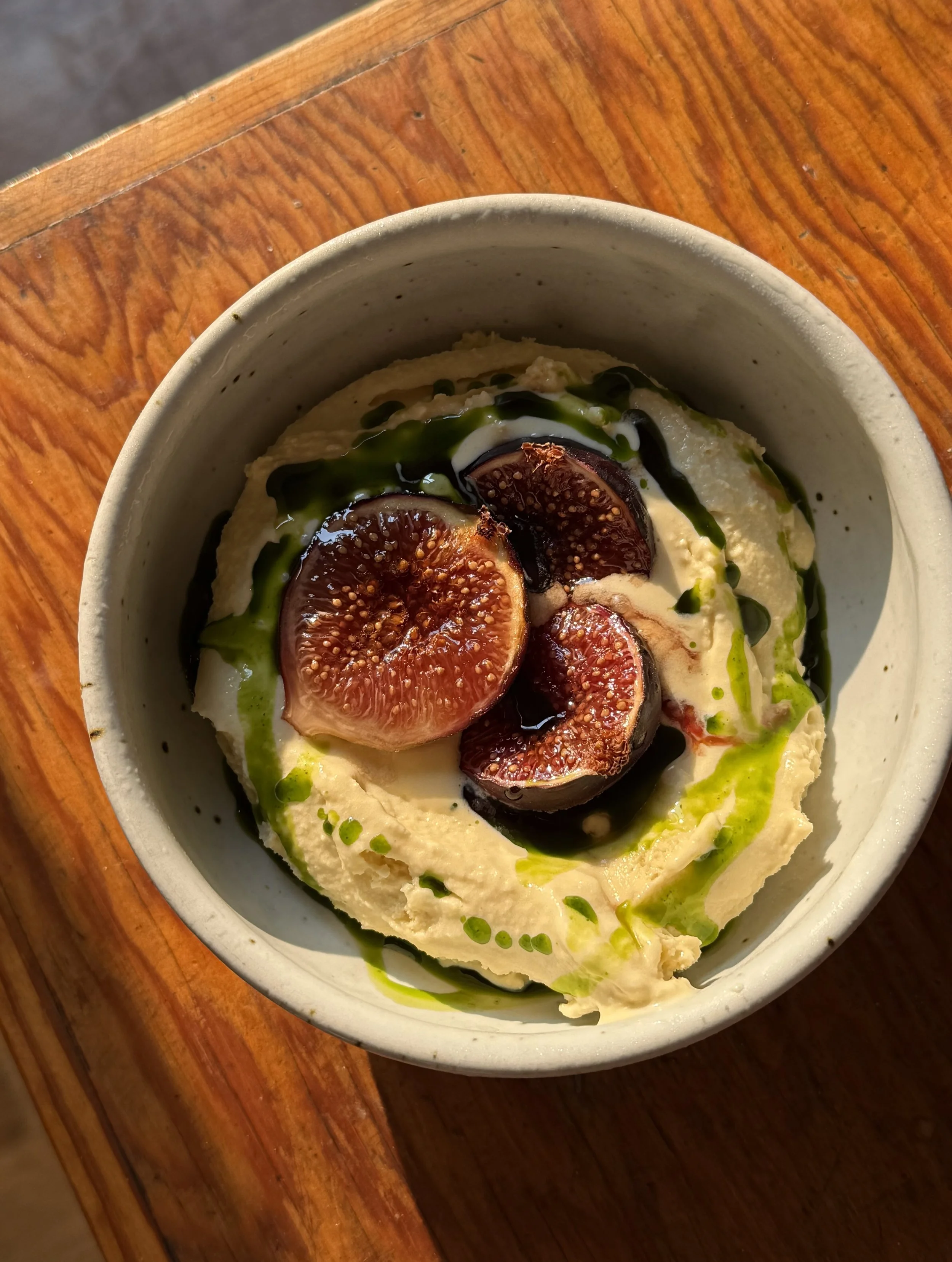
A simple custard base has three ingredients: cream, sugar, and egg yolks. Most recipes use a blend of cream and whole milk. Feel free to add vanilla, or infuse the base with any number of flavors. This week we’re serving fig leaf ice cream with roasted figs. When toasted, fig leaves have an intoxicating aroma of coconut, vanilla, and spice.
Making a creamy custard base is all about harnessing the thickening power of egg yolks. Eggs are delicate. Heating them gently unspools their proteins into a smooth gel, but heating them too fast or too hot makes them curdle. Two techniques help us hit the sweet spot.
Whisk the sugar and yolks together first. An even distribution hydrates the sugar and acts as a buffer to protect the yolks.
Tempering. Warm up the cream-milk mixture. Add about a cup to the yolk-sugar mixture, then whisk. This raises the temperature of the eggs gradually. Once everything is combined, heat the base (always slowly and gently) until it thickens (which happens at about 170°F).
Now that the custard base is made, it’s all downhill from here. Cool it completely. Since this isn’t a restaurant at the turn of the century (or grade school science class), we don’t have to bust out the rock salt and the tumbler. Spin your base in a handy-dandy electric ice cream maker.
A couple notes: making the custard base is the same basic technique that we use for crème brûlée and pastry cream, so once you get the hang of it, you’ll be a dessert fiend. Even the smoothest ice cream will eventually get freezer burn. Good news! Just let it melt, and re-spin it.
“When they ask me how I lived to be a hundred, I’ll tell them it’s because I ate ice cream every day.” This was something my grandpa was fond of saying, proudly and often. Now, did he live to be a hundred? That’s beside the point. It’s an outlook, a way of life.
Said another, more gruffly mustachioed way: “I eat what I eat, I drink what I drink, and I’ll die when I die.” Thanks, Ron Swanson. For me, the sweet spot is something we always used to say at the restaurant around two o’clock in the afternoon when the baristas would bring in the soon-to-be-day-old muffins and cookies for our perusal: “Life is short. Eat the pastries.”
We’re glad you’re cooking with us.
Cheers,
Sten and Mac
EXPLORE MORE