Texture
It’s the texture of a thing that makes it interesting. My father is an orthodontist, a very skilled one. I didn’t really appreciate this until I was well into adulthood. Instead, as a teenager, I was a…a rather willful patient. After I got my braces off, I wore my retainer for a month, maybe two, after which I informed my dad that I was done.
“You know, I can’t tell people this, because they pay me to make their teeth perfect, but if your teeth are too perfect, you look weird,” my dad said. “Imagine one of those shiny TV news anchors with bleached smiles.” (They’re probably veneers, anyway.) “So we try to get them 95% of the way there and then stop. Plus, “perfect” is a moving target.”
He went on to tell me how aesthetic best practices had changed during his career. To top it off, he went through a whole list of famously beautiful people with “imperfect” features that shouldn’t work. Scars and gap teeth and crooked noses. He loves to talk about how Reese Witherspoon’s chin doesn’t make sense.
A lack of flaws is unsettling. It registers as no longer quite human. This bizarro world of close-but-not-quite is called the uncanny valley. It’s the same reason why everyone hates animation that’s too close to reality. Our instincts tell us that a rickety Mickey Mouse cartoon is somehow more realistic than Tom Hanks’ deeply unsettling avatar from the Polar Express. Ew.
This is because perfection is not real. If only we could torpedo this concept into the underworld where it belongs, then maybe the chokehold of our collective stress would ease its grip. It’s the unexpected that delights us.
But randomness is also stressful. Practicing, systematically striving for improvement, meeting expectations - these are good things, too. Because delight doesn’t spring from chaos. It springs from irregularities, little nuggets of nuance, interspersed in a pattern. If I am ever able to internalize this duality - sustaining incremental effort without looking at the scoreboard - well, I think that’s nirvana, actually.
I’m supposed to be discussing texture as it relates to food. And I think we can all agree that I’ve done that quite well. I’ll leave you to draw the appropriate parallels.
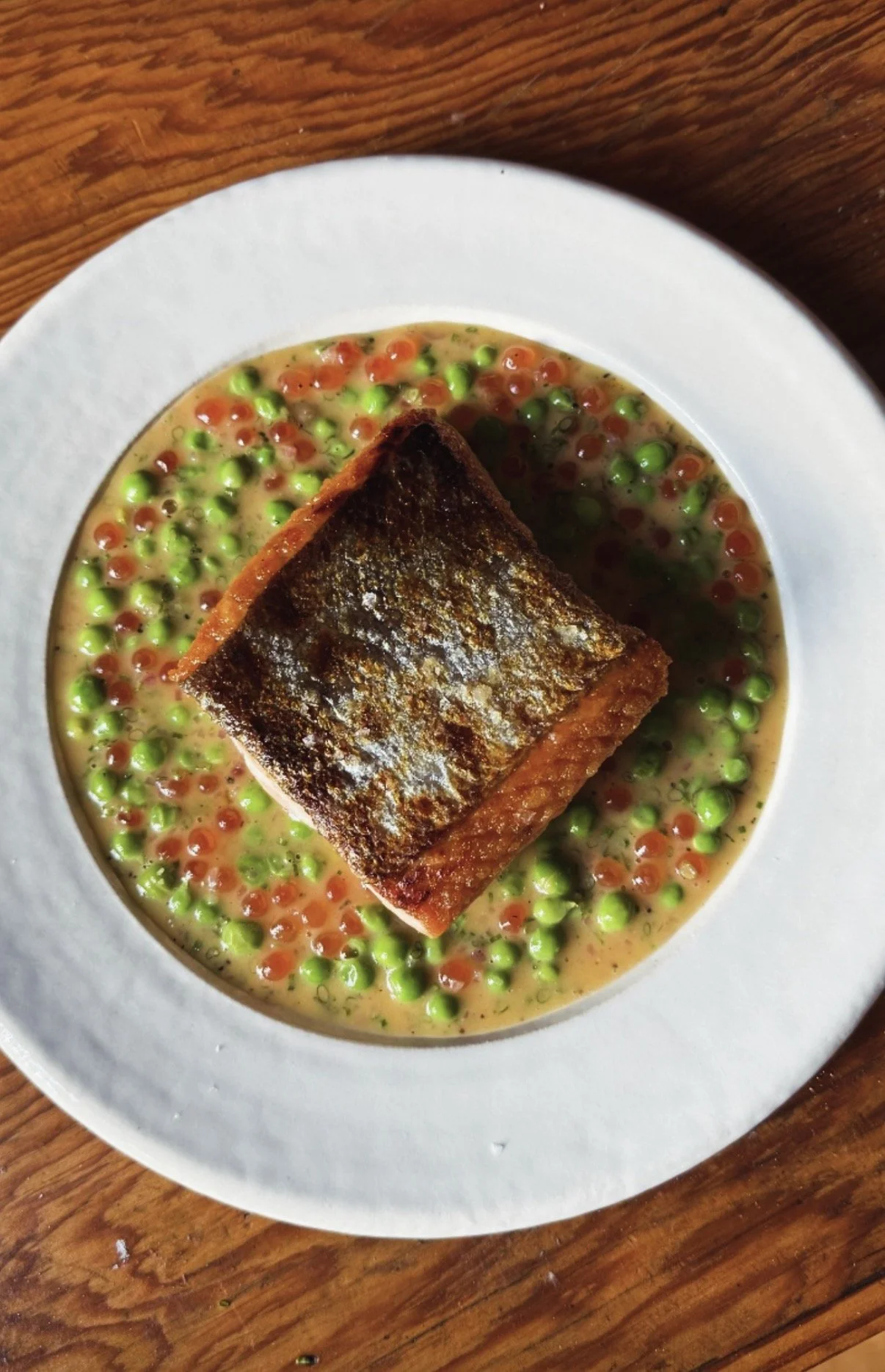
This week we continue our collaboration with Drifters Fish by serving one of Aster Pantry’s all-time favorite summer mains: seared salmon with ikura and English peas awash in a Meyer lemon beurre blanc. The ikura (cured salmon roe) and peas are almost the same size. They look like little orange and green planets floating in space. But the textures will surprise you.
We’re glad you’re cooking with us.
Cheers,
Sten and Mac
KITCHEN TIP
You can dry-brine salmon, too. I’m always skeptical of one-size-fits-all solutions, but dry-brining might be the closest thing to a silver bullet we’re ever gonna find. For salmon, it creates a firmer, juicer finished product which doesn’t release that cosmetically displeasing white ooze (coagulated albumin). Oh, and the skin will be crisper than Harvey Specter’s best suit.
You’ll notice the effects after one hour, but as per usual, overnight in the fridge is best.
EXPLORE MORE