Pickled Cucumbers
These are brined, lacto-fermented pickles. The cucumbers and aromatics are submerged in a concentrated salt brine, which dilutes as the cucumbers absorb salt and release their juices. Cucumbers mature in the heat of summer and contain a great deal of water. Thus, they have a tendency to get mushy. Notes throughout this recipe describe various ways to combat mushiness. The difference between “full sour” and “half sour” pickles is just a matter of how long we let them ferment. Finally, this recipe is written as a small trial, but once you get the hang of it, feel free to scale up.
Makes 1 quart jar of pickles
INGREDIENTS
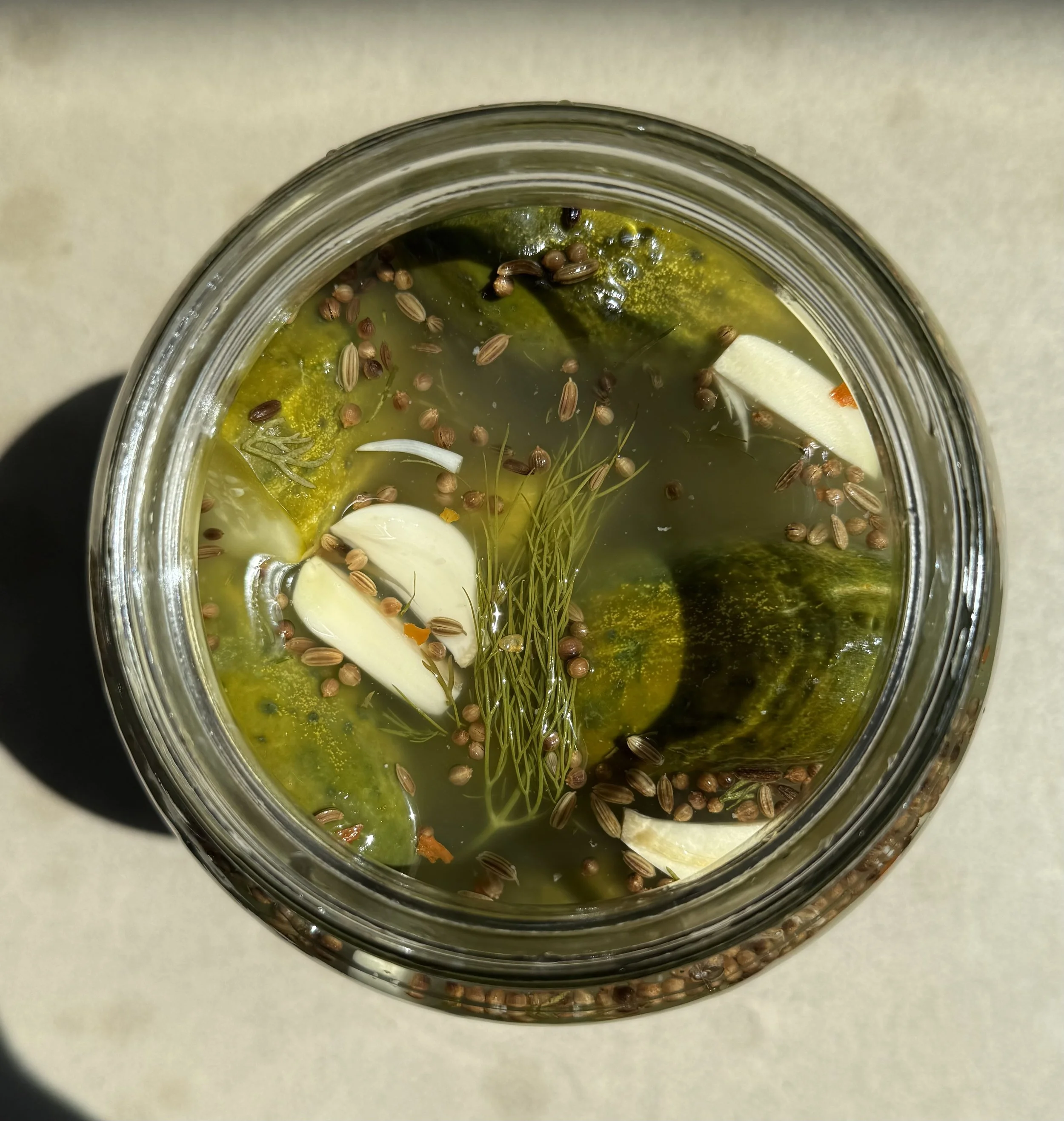
8-12 pickling cucumbers, the smaller the better
4 garlic cloves
4 sprigs dill, washed
1 tablespoon coriander seeds, toasted
Unrefined sea salt (see note)
2 grape leaves (see note)
METHOD
Soak the cucumbers in ice water for at least 1 hour. This helps firm up the cell walls. Scrape off any residue of the flower blossoms on the ends. The blossoms contain microbes with enzymes that cause softening.
Make a 5% salt brine. We do this by weight. For example, dissolve 25 grams of salt in 500 grams of water. The final salt concentration will vary slightly depending on how much plant mass ends up in the jar, but this should result in a final concentration of about 2-2.5% (see note).
Pack the jar. The listed quantities of garlic, dill, and coriander are just guidelines for what will comfortably fit in a quart jar. The goal is a completely full jar, though not so full that it crushes the vegetables.
Submerge the vegetables. Once packed, fill the jar with just enough brine so that the vegetables are completely submerged. It helps to weigh them down with…something. I often use a tiny glass jar. If your fermentation vessel is big enough, you can use a plate. At the restaurant, we often used a ziplock bag filled with brine. You can buy glass fermentation weights. Just make sure you don’t use anything metal - it will rust. Glass is best. Ceramic and plastic are also fine.
Cover, but do not seal, the jar. I generally use the lid, closed gently. You can also use a towel and a rubber band. The goal is to prevent anything from entering but also allow for pressure to release. Place the jar…somewhere safe. The warmer it is, the faster it ferments. I generally opt for a cool location, away from direct sunlight, but it’s worth noting that many folks (even commercial processes) rely on the UV radiation of sunlight to kill aerobic surface yeasts.
Wait. The only way to know when your pickles are done is by tasting frequently. Always be tasting. I let most vegetables ferment for at least 2 weeks, maybe 3. Not so with cucumbers (recall the mushy factor). Half sours need just a few days. They’ll still be somewhat bright in color (both interior and exterior). Full sours take a week or so, possibly 2. No matter what, put them in the fridge at the first sign of softening.
Note: Unrefined sea salt retains calcium and magnesium impurities which help reinforce the pectins of cell walls. This is one of several techniques to bolster crunchiness, so if you don’t have it, any kosher salt works.
Note: Adding any tannin-rich plant material to the brine helps keep your pickles crunchy. Grape leaves are the most common choice, but cherry leaves, oak leaves, or even a green tea bag will work.
Note: If you really don’t like estimating, you can fill the jar with all the vegetables and water you’re going to use, weigh it, calculate 2.5% salt, strain out the water, dissolve that amount of salt in the water, and then put the whole thing back together. Don’t forget to zero out the scale with the empty jar.
EXPLORE MORE