Food for Athletes
Spoiler alert: it’s vegetables. The answer is always more whole produce. I’m confident that everyone reading The Regular already knows this, which is also where the problem starts.
A close friend of mine once said that if she could consume all of her food in pill-form, she would. Just say goodbye to all that tedious food prep and chewing. As upsetting (and purposefully hyperbolic) as this assertion is, a milder version persists in our society, especially amongst athletes - this idea that food can be optimized.
For the last century, nutrition research has focused on measurable nutrient content. Proteins, vitamins, minerals, and fiber are good. Saturated fats, sugar, salt, and refined carbohydrates are bad. Food is the sum of its parts, and healthy eating is an equation. This ideology is responsible for innumerable diet foods and often referred to pejoratively as nutritionism (a term popularized by Michael Pollan in his book In Defense of Food).
Despite my dismissive phrasing, this framework has some merit. It’s a gross oversimplification of an incredibly complex biopsychosocial process, yes, but of course nutritional content matters. There’s a reason that, at the beginning of each season, dietitians send me their athletes’ macronutrient targets. You can’t crush the other team without fat, protein, and carbs.
But process matters also, whether in training, writing, cooking, or living. It’s the storyteller’s oldest lesson: the journey is more valuable than the destination. It matters how we do the thing, not just that the thing is done.
What I’m trying to say is that we’ve got to chew our food. Or rather, that we’ve got to eat food that requires chewing.
Utra-processed foods (UPFs) have been getting a lot of attention these days, thanks in part to the efforts of our very own roadkill enthusiast at the Department of Health and Human Services. On the surface, it’s an unnecessary and sensationalistic rebranding of the term junk food, designed to shock and radicalize.
On the other hand, despite my dislike of hucksters and talk of silver bullets, the reframing has some merit. It shifts focus from counting nutrients to considering how and why a food is made.
No one is surprised that eating an apple is better than eating a Twinkie. The discussion gets murkier when we consider protein powders, protein energy bars, energy gels, fortified breakfast cereals, and low-fat, sugar-free alternatives. These foods are engineered to be soft, energy dense, and hyperpalatable, which enables faster eating and digestion, which can lead to overeating and inconsistent nutrient absorption. Furthermore, what you’re not eating is just as important as what you are eating. As a percentage of total energy intake, more engineered food equals - you guessed it - less whole vegetables (and the unique phytochemicals they deliver).
Even if UPFs have contributed to the rise of diabetes and other chronic diseases (which would astonish exactly no one), is this really a problem for athletes? Shouldn’t they just flood the system to maximize protein intake (even if a lot of it goes right through them)? Are these foods really worse than eating bacon? If you ask me, yes. But my experience is anecdotal (and the current research, while suggestive, is limited and inconclusive).
As a performance chef, most of the athletes I serve are veterans. The young guys don’t bother. The players who seek me out have made it far enough in their careers to understand the benefits of listening to their bodies and honing their lifestyles.
For one of my clients, I provide pregame snacks on gamedays, light meals to eat three or four hours before the puck drops. During our first consultation, he said that, over the course of his career, he’d noticed that he plays better when he eats real food before the game. What’s telling is that this is the only directive he gave me. No specific nutritional guidelines.
Here’s an overview of my talking points for consultations. Start with a 75-25 audit. This is about patterns, not one-offs (I love potato chips, and no one is saying protein bars and Gatorade won’t give you a gametime boost). Do whole foods account for more or less than 75% of your diet? Two, what are whole foods? The answer is fairly complex, but it starts with buying 75% of your groceries from the exterior wall of the store: produce, bulk foods, dairy, and meat. Three, there’s no secret. The answer is, and always has been, vegetables and the Mediterranean diet.
As I said, we’ve got to chew our food.
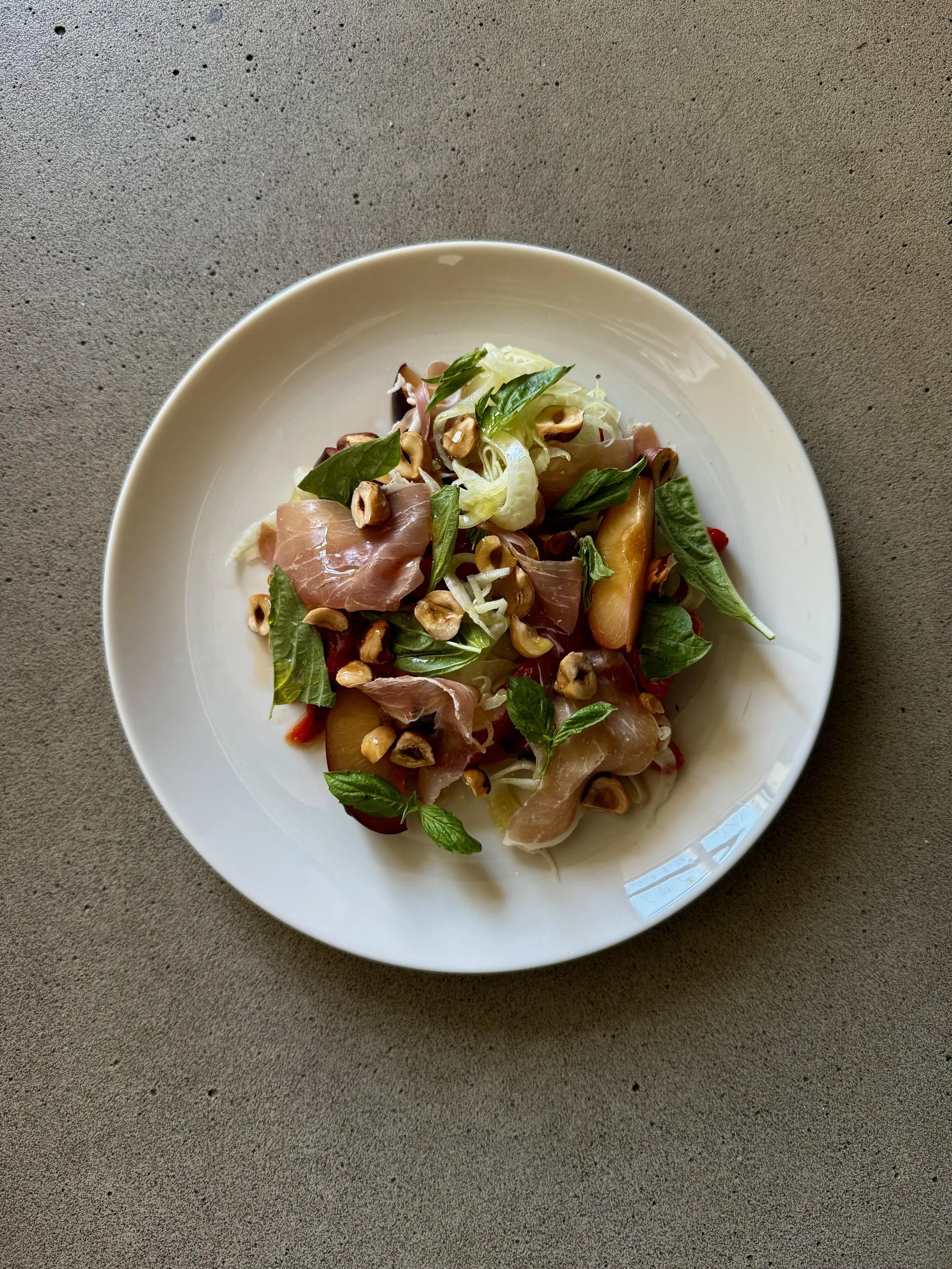
For lunch, I serve my clients a lot of hearty salads, largely so they worry less about vegetables at dinnertime (and partly because they travel well). In that spirit, this week we’re serving a medley of shaved fennel, nectarine, prosciutto, charred red pepper, hazelnuts, and basil.
We’re glad you’re cooking with us.
Cheers,
Sten and Mac
PERFORMANCE TIP
Savory breakfast. If you really want to boost your reps at the gym, one of my recommendations is to put effort into crafting a savory breakfast that you can both enjoy and replicate daily. No one needs variety for breakfast. In fact, most people like consistency.
I eat a porridge of brown rice, steel cut oats, and sunflower seeds with kale, peanuts, and a soft-boiled egg, topped with a fermented pickle du jour and fancy soy sauce. Basically, it’s congee. This works for me because it’s my job to make food. But there are plenty of less labor-intensive options.
I’m always happy to discuss strategies. Hit me up before I become a BFD and get to start charging for my advice.
EXPLORE MORE